




The Game of Ice and Fire
1. Description of the game
The Game of Ice and Fire is a strategy board game that based on the HBO series Game of Thrones. It includes 1 world map (based on the world map of Game of Thrones), 32 event cards (12 big events and 20 small events), 5 kinds of ability cards (2 kinds of common ability card and 3 kinds of special ability cards, 10 of each), 6 character cards, 6 character figures and 1 round counter.
1.1 The Map

World Map
The map has fifty seven spots in total, there are four starting spots (red), thirty small event spots (small blue), seventeen big event spots (big blue) and five ability card spots (orange). When player lands on starting spots on the map, nothing happens; when player lands on small event spots, the player picks a small event card; when player lands on big event spots, the player picks a big event card; when player lands on ability card spots, the player chooses to take one of the common ability cards. Every character has their own path on the map and there are cross roads on the way so that players can choose which way to go, and the shortest path for each character contains same amount of spots so that every player have the same length of journey.
At first our original map was ⅓ as big as the current one, and we soon realized that the game time is too short, so we expanded it in the second prototype. Then after second playtest, we decided to separate those spots into big ones and small ones so that players won’t have too much pressure at the very beginning of the game.
1.2 Ability Card
There are two kinds of common ability cards: Gold and Soldier, and three kinds of special ability cards: Direwolf, Dragon and Lion.

Ability Cards
At the beginning of the game, every player has one Gold, one Soldier and two special ability cards that is related to their character. (Details in Character section.) In the game there are some event cards that can provide player’s additional ability cards and some other events require players to discard some of their ability cards (details in Appendix: Event Card Description). Players can exchange their ability cards to form alliance.
The exchange ability card part is the core of our game’s aesthetic. When they exchange cards, they form alliance, they make deals, but as the game goes, they may not always keep their promises, and that’s when players can feel betrayal. This part has always worked fine in our playtests and we kept it from beginning to end.
1.3 Event Card

Event Card
Event cards provide obstacles or help to players. Some of them have mild punishment or reward and they are called “small event”. Some of them have pretty serious consequences and they are called “big event”. (Details of event cards description see Appendix.) The event cards that can be kept for later can also be exchanged between players in the game process.
At first we only had 15 identical event cards and they all asking for ability cards and obviously it was boring, therefore, we decided to add events like “Wildfire” “Horse” and “Trap” that can give players some power in hand and they can increase player interactions. Then in some playtests we found that players may get more and more ability cards in hand and they don’t need to negotiate with others, so we added two ultimate war cards “Clash of Kings” that we hope can completely change the game status. Before we put the “Clash of Kings” into our game, we analysed its risks: Maybe it cannot actually make players discard enough cards to change the game; maybe it is too complicated for players to understand. After the final playtest, it turns out players assumed that they don’t have to discard their ability cards after the war so they just used all of their cards. It was our fault for not making that clear. However, after understanding the rules of clash of kings event, all play testers seemed to like this event.
1.4 Characters
We chose six typical Game of Thrones characters into our game and they all have different starting spot and destination spot.
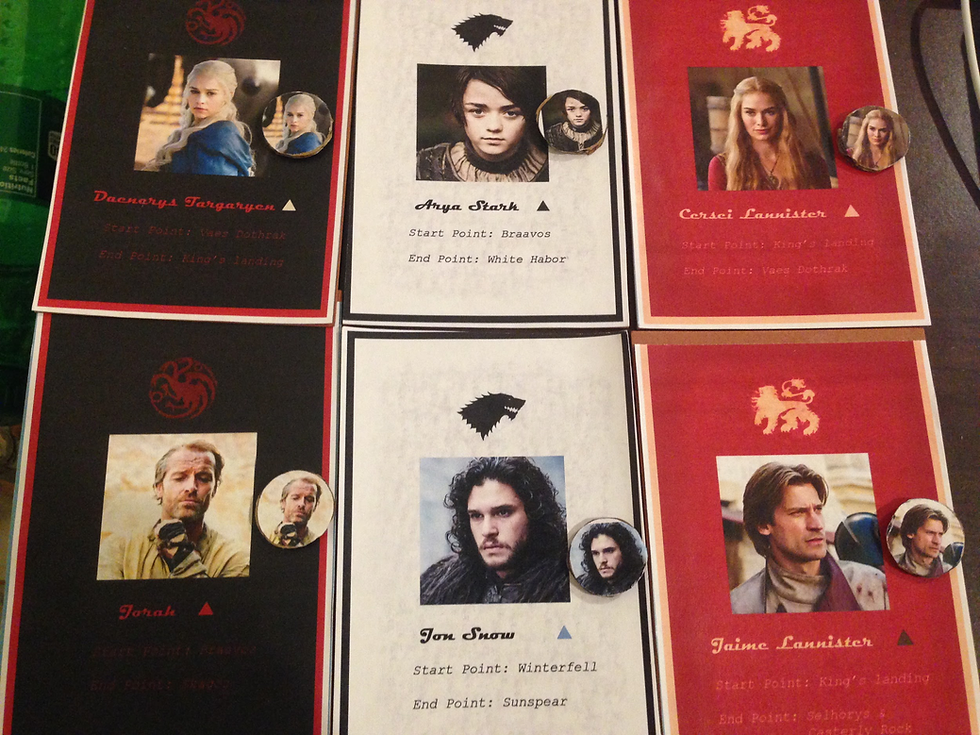
Characters
Details of characters and their related ability cards are listed in the form below:
Character Description:
Character name House Ability card Starting spot Destination
Cersei Lannister Lion King’s Landing Vaes Dothrak
Jaime Lannister Lion King’s Landing Casterly Rock & Selhorys
Daenerys Targaryen Dragon Vaes Dothrak King’s Landing
Jorah Targaryen Dragon Braavos Skagos
Jon Stark Direwolf Winterfell Sunspear
Arya Stark Direwolf Braavos White Harbor
In former versions of our game, the winning goal for players were more complicated. Some characters needed to meet two other players to win; some characters needed to trigger enough events to win. We all agreed that these rules were more interesting, but we couldn’t find a way to perfectly put them in the game without overpowering them, so we decided to make their winning condition consistent: all move from one spot to another. And we found that players are having trouble remembering their destination and other players’ destinations, so we made a character card for each player. We also add marks on the map as a reminder of the endpoints. These allow the player to check the progress of the game much easier than the older versions.
1.5 Mechanic
The player from house Targaryen starts first (if there are two of them, then Daenerys starts first), then the round proceeds clockwise. Each player moves one spot per round, and if lands on event spots, player picks an event card and take actions as it says. After every four rounds, every player can pick a special ability card related to their character. The player who first reaches the destination wins the game. The game can have multi-winners if players can reach their destination in the same round.
At first our game could only have one winner, and we changed the start player every round to try to make it fair to everyone, but as it turns out in some cases a player may be the last to take action in a round and the first to take action in the next round, and this situation can give one player more advantage than the other. After some discussion, we decided that instead of fixing this loophole, we abandoned this round-starting mechanic and now the multi-winner mechanic works fine for now.
2. Final Playtest

Playtest in class
The final playtest was held on Wednesday October 19 in the class. Three classmates were chosen as the participants of the game. One of them had watched the Game of Thrones TV series and two had not. We spent about 5 minutes to explain the rules before the game starts. There were several unexpected questions in game at first, like confusion about which is common ability card and which is special ability card, and which card should they pick when they have the chance, but players got the feeling and the way to victory pretty soon. The whole game process was smooth and we didn’t encounter any serious error. It took us about an hour to finish the playtest, but we feel that is exactly the expected game length of a full game. As players did not get bored during the game.
Comparing to last playtest, we added several new mechanics like round counter and war. The round counter is relatively simple to understand and the players liked the dice. They did not even need our help to keep the round counter working after few rounds. The war mechanic is relatively complicated comparing to other elements of our game, but we do like this idea and want it to be addressed as a turning point in big events. In the actual playtest, the players were learning pretty fast about how the war works and how should they deal with it. One player spent two ability cards in trading for not being chosen as the target of war, and that was a choice we were anticipating for the players to do when we designed that event.
After the playtest was finished, the players seemed to be excited about the game even though they barely know the background settings of the game. We had several questions about their experience:
Are the rules easy to understand?
Did you felt betrayed?
What do you think that can be improved in our game?
Did you enjoy our game?
From their answers, we know that they felt no trouble understanding the rules of the game and kept it working well. They liked the designs of the events and enjoyed the trades. When we asked if they felt betrayed, one player replied instantly “I’m betrayed!” and other players agreed with him. For our third question, they mentioned that they were kind of experiencing too much trade off in the later game; they just can’t stop arguing with each other. They think it was fun but maybe a little too much. That is a new problem we have never considered before this playtest. And overall, they all said they were enjoying our game. Thus we believe that this is a rather successful playtest.
3. Lessons Learned
3.1 Insights Gained
We learned that players don’t know this game as well as us so when they are first introduced to the game, their experiences could be more confusing than we expected. For example, in our former prototype, the image of our Gold ability card was a crown made of gold and has a Game of thrones slogan below it; the image of our Soldier ability card was image of Unsullied which only make sense to Game of thrones fans. At first we felt good about these designs, but after playtest we realized that they were too confusing for new players: It says Unsullied on the card but we are calling it Soldiers; it is a crown but we are calling it Gold. So through this we learned that while designing we need to pay attention to consistency.
Another confusion for players in our former prototype is that they don’t know if they should discard their ability cards after they encountered an event because we didn’t make that clear in the instructions that shows on the event card. We assumed that players know they need to discard when they used an ability card but they actually don’t know that. From this we learned that we need to make everything clear when we design.
We also learned that to achieve the aesthetic, we need to figure out what verbs players do, can make them have the experience that we want them to have; to make them feel the aesthetics. Nervous and betrayal have been our aesthetics from the very beginning, but when we first sit together brainstorming about our mechanics, we were literally only thinking about mechanics, and that afternoon we made a lame prototype that we don’t even want to play it after five minutes. Then we began to think about our aesthetics. To make players betray each other, they need to first form alliance and then the game needs to give them a reason to split up, and that’s when we came up with the exchange cards idea which turns out to be really helpful to give player a sense of alliance and betrayal.
3.2 Communication
We had multiple ways to communicate with each other during this project period. We set time to meet in the library to discuss and brainstorm; we have a group on Whatsapp so that any of us had an idea can send it to us immediately and we can talk about it efficiently; we talk to each other after every class, to set our next meeting, to ask each other if there were any problems with our on-going tasks; we opened a google drive document to write our game’s rule book and use it to update our ideas after we have done each iteration and we also use it to talk to each other while writing on the document. We all felt that these communication process were efficient and they can all be brought forward to future projects, but what could be added in the next project is an One-Page Design document. The rule book is necessary but an One-Page Design will be a clearer way for teammates to communicate.
4. Projection
We are very proud of our work but we also know there is a lot that need to be improved; our game is far from perfect.
When we playtested our final prototype with some friends outside the class, we used 6 players, and it turns out the game last extremely long and players all get exhausted. So obviously our current map is way too large for a 6 players game. Considering that our game is all about alliance and betrayal, more players would be more fun, so we need to adjust our map to make it playable for more than three players. Maybe we can shrink our map and cut 1/3 of the spots and then do another 6 players playtest and see how long it will last.
Another problem is that during our game, most of the time all players are moving synchronous; they have the same distance from their destination, so no one wants to use their “Trap” “Horse” “Wildfire” events. So we plan to make their movement more dramatic. We are considering to add some shortcuts on the map and if players want to go through, they have to give up certain amount of ability card. For example, player has to give up three Gold cards to use one of the shortcuts. We believe this new mechanic will encourage players to use those event cards and have more interaction with each other.
We are also considering to change the mechanics of “Horse” and “Wildfire” cards. Maybe we can let players to decide how many steps they want to send their opponent forward or backward. For example, if they want their opponent to move backward for three steps, they’ll have to give up three ability cards, if two steps, then give up two ability cards. But this is merely an idea, we really need to playtest to see if this can work.
After our in-class playtest, one playtester was complaining that there were too much bargain between each other. Although making players argue with each other is our goal, we don’t want it to be too much, so we may need to add some restrictions about what can be exchanged between players instead of let them exchange everything. Maybe we can restrict that only ability cards can be exchanged and event cards cannot.
5. Teamwork
As mentioned in the Communication section, we used a lot of ways to communicate and they were all pretty efficient. Another thing that worth mentioning is that we really argued a lot with each other when we designed our game, but it was actually a good thing for our game because that was the process of solving our problems, and also because of our mutual respect, the argues were pretty polite and didn’t last too long. For example we argued if we want to add a dice into our game to give our game more randomness. The pros are that it will solve out turn-starting problem and it could be more fun; the cons are it contrasts our strategy game theme and it may cause a player to win just out of luck. Finally the cons outweigh the pros and our argues settled. Overall we really had a great time working with each other.
Our roles and tasks:
Jing: Did all the visual design of the game, printed and made all the cards and maps for the first and second prototypes. The team printed and made the final prototype together. Participated in all three blogpost writing. Attended to every team meeting and contributed ideas.
Shi: Participated in all the blogpost writings. Attended all the meetings. Designed the first version of the map and characters. Designed the skeleton map and characters of the second and final version. Refined the text of all the event cards and designed new events for second and final version.
Ala: Participated in all the blogpost writings. Attended all the meetings. Made the character figures. Searched for photos of characters and ability cards. Helped with making the final version of the map and the event card.
APPENDIX
Event Cards Description
In order of:
{Name of events
Basic Description
Benefit
Loss
Number of copies
Type of events}
Dragon Event
You encountered White Walkers.
You can discard one dragon to defeat them.
Or you’ll have to stay for a round.
1
Small
Dragon Event
Boltons are attacking you.
You can discard one dragon to eliminate them.
Or you’ll have to go back for one step.
1
Small
Dragon Event
If you have a Direwolf in your hand,
You can move two steps forward.
1
Big
Direwolf Event
If you have a Direwolf in your hand,
You can pick one ability card.
1
Small
Direwolf Event
You are lost in the woods.
You can discard one direwolf to find the way out.
Or you’ll have to stay for a round.
1
Small
Direwolf Event
You encountered Giants.
You can discard one direwolf to fight against them.
Or you’ll have to discard two ability cards.
1
Big
Lion Event
If you have a Lion in your hand, Keep this event for later.
Next time you encountered an event, you can force one of your opponents to give you one ability card.
1
Small
Lion Event
Greyjoy’s castle ahead and they won’t let you pass.
You can discard one lion to make the way through.
Or you’ll have to go back for one step.
1
Small
Lion Event
Lord Varys is spying you.
You can discard one lion to bribe his little birds.
Or you’ll have to discard two ability cards.
1
Big
Solider Event
If you have a Solider in your hand,
You can pick one ability card.
1
Small
Solider Event
The masters from Slaver’s Bay are trying to make you one of their slaves.
You can discard one soldier to free yourself.
Or you’ll have to stay for a round.
1
Small
Solider Event
There is a river ahead
You can discard one soldier to build ships.
Or you’ll have to go back for one step.
1
Small
Gold Event
If you have a Gold in your hand,
You can pick one ability card.
1
Small
Gold Event
You have been framed by littlefinger and now you’re going to be sent to the red keep.
You can discard one gold to bribe the guards and leave.
Or you‘ll have to stay for a round.
1
Small
Gold Event
You encounter robbers and they are asking for gold.
You can discard one gold to keep yourself safe.
Or you’ll have to give two of your ability cards to any other players.
1
Big
Wildfire
You can keep this event for later.
At the end of a round, you can discard one ability card and this event card to send one player one step backward.
3
Small
Horse
You can keep this event for later.
At the end of a round, you can discard this event card to let one another player to move one step forward.
3
Small
Trap
You can keep this event for later.
At the end of a round, you can discard one ability card and this event card to send one player one step backward.
3
Small
One day of peace
Target another player. The targeted player pick one ability card and you pick two ability cards.
3
Big
Ultimate! Economic crisis
Every player must discard one gold ability card.
Or he/she must discard two other ability cards.
1
Big
Ultimate! Invasion of Wildlings
Every player must discard one solider ability card.
Or he/she must stay for a round.
1
Big
Preparation for Winter
Every player in your house get a special ability card related to your house.
1
Big
Clash of Kings
Target another player for a war.
Both player choose part of their ability cards as the sacrifice for the war secretly. After both players have made the decision. Reveal the number of cards and the player who sacrifice more win the war.
Winner take one random ability card from loser’s hand.
If there is a tie, the challenger lose the war.
2
Big
Comments